

I flew home from Detroit on Saturday. An uneventful, short flight, but I spent most of it reflecting on the week behind me.
Last week I completed the Chief Data and AI Officer program (CDAIO) at the University of Michigan, jointly delivered by the Ross School of Business and Michigan Engineering. Twelve live virtual sessions, a decent reading list, and four months of coursework, capped by a week-long intensive in Ann Arbor. It mattered more than I expected, and it took a few days back home to understand why.
The week changed how I see AI and its practical use in business. It also changed how I think about investing yourself in a program of this kind. I knew going in it would not be only workflow automation and the history of AI + ML. I did not expect how deeply the program would land on strategy, governance, and value creation. The caliber of the faculty, the facilitators, and the cohort matched the depth of the curriculum.
This is not a piece about credentials. It is about what the program crystallized for me and the people who made that possible.
What I came in for
I went in looking for three things.
Technical fluency. I’ve been obsessed with learning about AI for some time. It was something on the radar with “artificial intelligence” in CRMs serving up recommendations of who to stay in touch with etc, but to have seen a chat interface make it so accessible like ChatGPT and later my “AI de jour”, Claude, I have become a student, enthusiast and all-around evangelist. For the better part of the past three years, I have been driving AI deployment inside the brokerage I help lead, mostly through experimentation... workflow automations, content generation, agent productivity tools, and more recently developing an AI hub built to be a resource to house everything about AI in our org. The results have been real. Eighty-one percent employee adoption in four months since launching Gemini for Workspace. Forty-three percent of agents - picking up the tools organically, finding their own creative and productivity uses. But I wanted to formalize my framework. Move from tactical wins to strategic integration with the kind of rigor that survives scrutiny.
A robust peer network. I have built a meaningful network in real estate and proptech over the past twenty years. What I did not have was a room of senior leaders from outside my industry wrestling with the same fundamental questions. AI is a horizontal shift. Most of the best thinking is happening in conversations across industries, not within them.
And one more thing I would not have admitted as cleanly going in. I wanted to test myself. To sit in a room of accomplished leaders, leave my title at the door, and find out whether what I had been building on my own held up.
All three got more than I expected.
The shift
The deepest shift was something I had felt for a while but could not articulate cleanly until last week.
AI is not just a technical conversation. It is an implementation conversation. It’s a value creator.
The headlines are not the work. The companies and institutions that benefit from this shift will not be the ones with the loudest announcements. They will be the ones who do the patient, unglamorous work of integrating AI into how they actually operate. Data foundations. Workflow redesign. Governance. Cultural adoption. The hard parts.
That thesis came alive across multiple sessions. A few stuck especially hard.
Strategy as explicit trade-offs
Chris Rider opened a session telling the story of Volkswagen’s 2012 global strategy. They wanted to overtake Toyota. They wanted to make cars cheaper to build. They wanted to add environmental safety and energy features that would boost the perceived value to customers. They wanted to be number one across every dimension.
Then he made the point that has stayed with me. You cannot be number one across every dimension at the same time. You have to make explicit trade-offs, or you make implicit ones at your own risk. The phrase he used was that silence becomes tacit approval. When leadership does not articulate the trade-offs, employees make their own. For better or worse.
I felt that one in my chest. We have 1,100+ real estate agents and more than one hundred employees. They are not waiting for us to define their relationship with AI. They are already defining it. Adoption is happening. Creative use is happening. Productivity gains are happening. But in the absence of a clearly articulated strategy, every one of those people is making their own trade-offs about what good looks like, what the firm endorses, where the line is.
That is the gap I came home to fix.
Professor Killaly’s AI Strategy Canvas, which framed the entire four months, is the spine for that work. The discipline he built into the framework forces the question I have been avoiding. How does AI enable us to win with our most attractive clients, against our strongest competition, today and into the future? And then the deeper one. Will AI let us win by increasing the value of what we deliver, by decreasing the cost of delivering it, or both? Is the advantage durable?
That is value creation as a lens. Not AI as a tool. Not AI as a feature. AI as a value creation engine, with explicit trade-offs and explicit accountabilities.
Implementation that holds up
Eric Charran ran a session I will be returning to for years. Eric is now VP of Architecture at Salesforce. Microsoft, Capital One, and Intuit before that. He speaks like a builder who has had to make every framework he teaches actually deliver.
A few of his lines stuck.
The trap of the executive AI loop. Shareholders pressure leaders, leaders freeze headcount, leaders chase every tool, pilots prove something is possible, the proof of concepts ends, and nothing actually changes. Most proofs of concept end up in that space. The successful MVPs attach to dollarized ROI and business value up front. Not abstract value statements. Not days saved. Real dollars, monetized against actual headcount cost, tracked from hypothesis through implementation through ongoing fiscal reconciliation across the lifespan of the solution.
AI dysmorphia. Assuming a probabilistic large language model is the right answer to a deterministic problem. LLMs correlate, they do not cause. Their aperture is too wide. Without a tight agentic flywheel grounding them, they hallucinate. Before you reach for the shiny tool, ask whether the problem you are solving is actually the kind of problem the tool can solve.
Make it small. Eric pulled the line from Man of Steel. Young Superman tells his mom the world is too big. Martha Kent answers, then make it small. Run four-week sprints tied to a single use case. Build a parallel house one room at a time. Let your customers migrate themselves out of the swamp instead of trying to drain the swamp first.
That section of the room reframed how I think about scope, about ROI, and about the patience this work actually requires.
Adoption as a network problem
Professor Maxim Sytch’s sessions reframed adoption itself.
The technology adoption S-curve is not new. What was new for me was the emphasis on informal power and the specific people who move organizations through the curve. The mavens. The early adopters. The influencers who are not necessarily at the top of the org chart. The folks at the intersections of workflows whose enthusiasm or skepticism becomes the social proof that activates the bandwagon effect.
That reframing matters operationally. We have those people inside the firm right now. The eighty-one percent employee adoption, the forty-three percent agent adoption I mentioned earlier did not happen because someone mandated it. It happened because the maven curve activated. Influencers across our offices started using the tools, telling other agents about them, showing what was possible, validating the work.
The job now is to make that explicit. Identify those people. Resource them. Listen to them. Build the strategy around their judgment, not just around mine.
The long view
John Thompson is a separate category. Forty years in artificial intelligence, machine learning, data and analytics. He has lived through the AI winters. He has seen what actually creates value over decades and what creates noise for a quarter.
He spoke without BS, and the room felt it. That kind of credibility cannot be performed. It accumulates.
What he gave us was perspective. AI did not arrive in 2022. The companies and minds doing this work have been at it for sixty years. The current wave is real and meaningful, but it is also one wave in a longer arc, and the leaders who treat it that way will make better decisions than the ones who treat it as the first or only one.
I am going to read his book, The Path to AGI. Twice, probably.
Jennifer Tejada, who runs PagerDuty and sits on the board of Estee Lauder, hit a similar register from a different angle. Roll up your sleeves. The work is the work. The features are not the point. The business problem is.
The whole faculty was extraordinary. The through-line was singular and they each carried it in their own voice. AI is not the noun. Value creation is.
The cohort
Forty-five leaders across industries and geographies. Healthcare, consumer goods, financial services, logistics, technology, and me - residential real estate. Different sectors, same questions.
They were the same questions everyone wrestled with. How do you align a team with uneven AI fluency, govern responsibly without throttling velocity, and build a data architecture that serves the strategy rather than constraining it. And how do you bring people along while you do all of that.
There is something specific that happens when forty-five accomplished people who are not selling each other anything are willing to sit in a room and admit what they have not yet figured out. I am leaving the program with a group of peers I expect to stay in touch with for years.
One moment from the week brought it home.
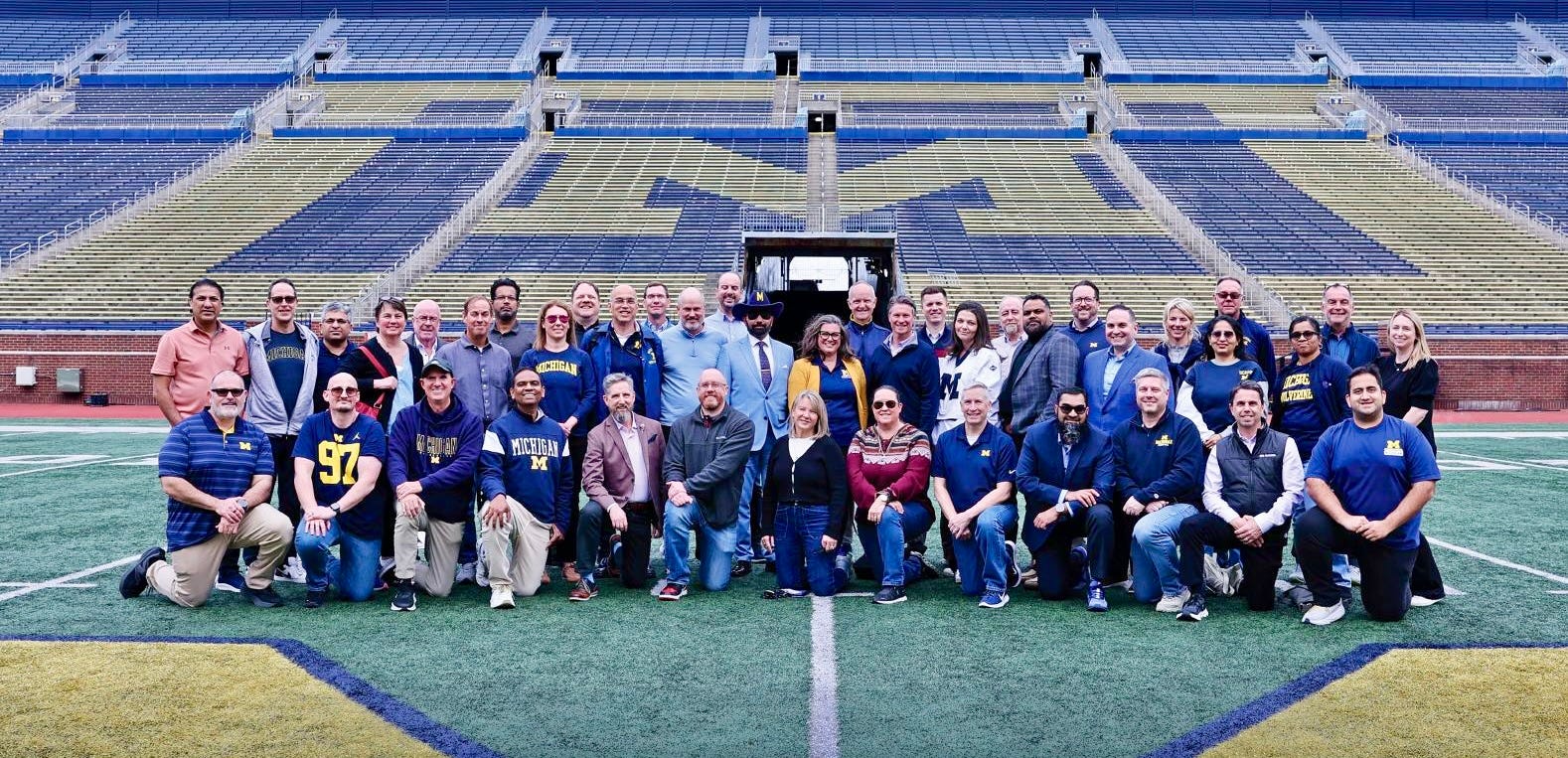
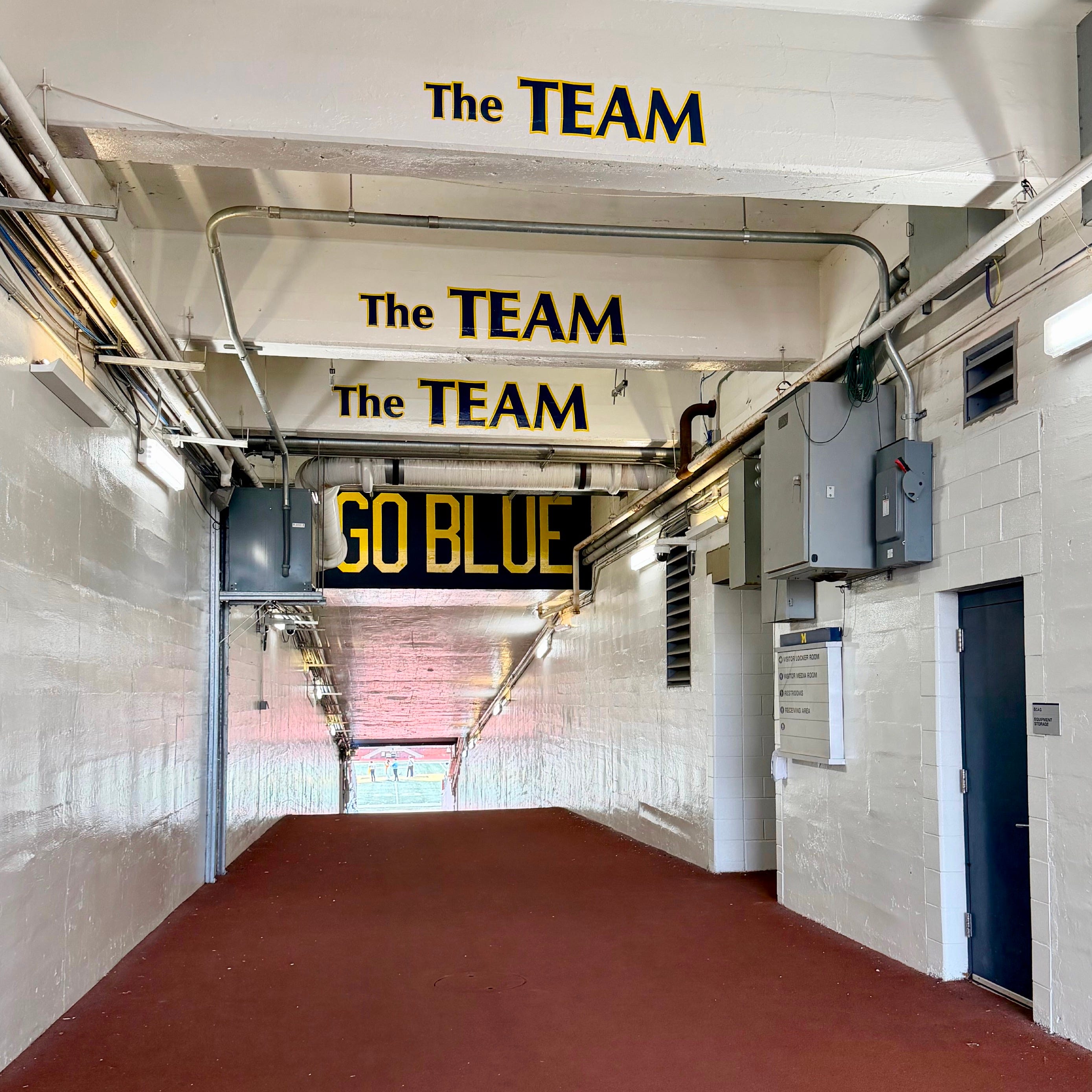
The program took us for a tour of Michigan Stadium, “The Big House”. The largest stadium in the country by seating capacity. We walked the tunnel from the locker room to the field. Three overhead crossbeams painted in sequence as you walk under them: “The Team. The Team. The Team.” It is from Bo Schembechler’s 1983 speech and it remains a guiding principle of Michigan football and of the school itself. One more crossbeam before the field: “Go Blue.”
We took our group photo on the field.
The phrase is a coaching idea, but it became a fair description of this cohort. Forty-five people who showed up for each other across four months, asked the harder questions, and gave each other their actual thinking instead of their polished thinking.
The team. The team. The team. That is what I am bringing home too.
Coming home
The certificate goes in a frame somewhere. All of the notes on top of more notes comes with me into the next phase of work.
I am not the same person I was in January. I have a sharper framework, a stronger network, and a more honest sense of what this shift is going to ask of leaders who want to lead through it. I also have more humility about how much of this is going to be about people, not technology. The hard work is always the human part.
The brokerage I help lead is already in motion. Agents are finding creative and productivity uses on their own. The maven curve activated. The wave is real and we are on it.
The work now is to make the strategy explicit and articulate the trade-offs so my team is not making them in silence. Resource the influencers. Define what value creation looks like in our specific context, with our specific clients, against our specific competition. Use the canvas to map every assumption against every stakeholder, and keep doing the unglamorous integration work that actually compounds.
To Brad Killaly and Jenna Wiens, thank you for designing and leading a program that respects the operators it serves. To Reva Bourgasser, thank you for being simply exceptional. The kind of person who runs the room without needing the room to know it. To all of the faculty and speakers: thank you for the rigor, the candor, and the perspective. To my forty-five Cohort 2 peers: thank you for engaging in meaningful ways, and thank you for joining me on this journey. The future is bright for us all.
Now back to it.